
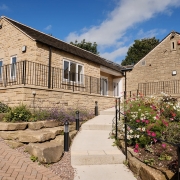
A stone house with a sloped roof, garden, and pathway under a blue sky with scattered clouds.

From the Chair December

We spent much of our twelfth and final meeting of 2025 discussing our final response to the National Park’s consultation on its preferred approach to a new Local Plan for the area.

As a Council, we have quite strong views on this. We believe that the current approach is too hostile to housing development in the National Park. It would lead to an undersupply of housing through the 2030s, and an inadequate supply in particular of the type of housing needed to attract and retain families to the area.

Indeed, we believe that the National Park is not properly squaring up to its responsibilities to put in place a Plan that is realistic. The current proposals are that only “affordable” housing could be brought forward, and that there should be no open market commercial housing. But the Park’s analysis shows, convincingly, that developers will not be able to deliver affordable housing without cross-subsidy from commercial development. So the Park has brought forward proposals which are not only misguided (in our view) but are undeliverable (not just in our view, but as a matter of cold hard fact). I think that’s pretty poor.

The population of the Peak District is declining, and its median age is rising. The longer this continues, the more communities will be hollowed out, and the less sustainable shops, public transport, and schools will be; and so the downward spiral becomes steeper. Of course, the character of the landscape needs to be protected, and we are conscious that the Peak District is an asset for people in Sheffield and toke-on-Trent as much as for its residents. But we believe that the current stance from the National Park underestimates the potential for development within existing villages, or on village fringes without eating into valuable countryside. A mid-century Peak District that’s a cross between a museum and a well-heeled retirement community is not in anyone’s interest.

So we’re making strong representations about this – as, I believe, are a number of our neighbouring parish councils. And I think we’ll need to keep making the case for our views, not just within the formal planning process but politically. You could see this as suggesting a tilt in priority from landscape protection to sustaining communities, but I’m not sure it’s as strong as that. Rather, it’s a view that current policy significantly understates the potential for sensitive and well-placed development which doesn’t damage environmental and natural objectives.

Best wishes from your Parish Councillors for a Merry Christmas and a good 2026.

A stone house with a sloped roof, garden, and pathway under a blue sky with scattered clouds.

From the Chair November

Chair’s note, November 2025

It’s that time of year. The low levels in the reservoirs perhaps mean that our baseline risk of flood is lower than in previous years; all the same, it has been pretty darn wet….

One of the things we’re asked to do as a Parish Council for an area at risk is to appoint flood wardens, who can co-ordinate activity when flood is threatened or has materialised. As a council, we’ve been very grateful to first John W and Nick, and then John B and Bob, who have retired from their roles after several years service.

Happily, we ‘ve been able to recruit new flood wardens quickly, in time for the period of peak risk. The council is hugely grateful to Sam Marsh and Chris Owen for putting their hands up. Both have already undertaken the necessary training, and both came to say hello to councillors at our November meeting.

It can’t be overstressed that we expect our flood wardens to stay dry (well, to have dry feet at least). They absolutely are not there to take risks, or go into or even close to flood water. The role is to disseminate information and coordinate activity in real time. Having people who know what is supposed to happen, where stuff is, who to contact, etc, is an enormous boon when stuff is happening quickly and lots of people
are trying to help.

Our parish clerk has also had flood warden training, so that potentially gives us three pairs of hands.

As well as flood wardens, it’s good practice to have a Flood Response Plan. We do have one, but it needs a little tidying and updating. The idea is to have a document which presents in simple form information that will be useful in a flood: in particular contact details, and information about our at-risk properties and who lives there. Let’s hope none of this is needed in the coming months. But the team is ready if it is.

From the Chair October

We realised at our October Parish Council meeting that there is something a “heritage theme” to our delivery priorities at the moment, including:

  • The provision of new signs bearing the sometimes-forgotten names of Grindleford pathways;
  • Work to restore the stone trough on SWHR;
  • The creation of a Grindleford archive;
  • Working with the War Memorials Trust to make some small but important refurbishments to our War Memorial.

All of these are important and I think right for us to support. People don’t want to live in just a group of houses, but in a distinctive community with a memory, and with stories to tell. As ever, on all of these things progress will take time, but we are moving forward on all fronts.

But we’re also looking to the future. We all hope there won’t be flooding over the next few months, but it’s great that we have two new and already-trained flood wardens. Our thanks to xx and yy for stepping forward. I went to the Derbyshire Association of Local Councils’ annual meeting at Pride Park last week, and the importance of flood wardens and village flood plans to the Environment Agency and the blue light services was made very clear.

I also – it was a busy week PC-wise – went to the National Park’s annual forum for Parish Councils in Bakewell on Saturday. The Park will soon be launching a consultation draft of the new Local Plan, following earlier preparatory discussions in which we participated (some of you will have come to the meeting we ran as a Parish Council earlier in the process). We’ll want to take a view on the approach to housing numbers suggested. Personally, I don’t think the Park’s current thinking is too far off, but there is a key issue to be resolved about the need for some open-market housing to make affordable housing feasible for developers. Let’s see what the final draft looks like.

The New 2022 Jubilee Walks

The Queens Walk

A short walk within the village for the Jubilee celebrations on 5 June.  It can be done in two halves.  There are 25 points of interest on two loops; 11 on one and 14 on the other.

Start:  both walks start at the phonebox

Finish, the Bishop’s pavilion

Distance:  the northern route by Padley Chapel, 2.14 miles 225 ft elevation

Distance:  The Southern Route, by Fair Flora, 145 miles 150 ft elevation

See Full Route here 

THE QUEEN’S PLATINUM JUBILEE WALK – GRINDLEFORD

A walk on rights of way, permissive footpaths and lanes, 12miles long, an ascent of 672feet. It can be done in one or split into two sections of around 6 miles each. It is also possible to walk shorter sections by using local bus services 275 & 65. There are opportunities for refreshments on or nearby it, a route full of interest with many stunning views.

The route starts and finishes from the Community Shop at St Helen’s Church and is as follows; Froggatt Wood – Froggatt Bridge – Eyam New Road – Goatscliffe – Adlington Lane – Sir William Hill – Sandy Lane – Leam – Hogg Hall – Leadmill – Harper Lees – Coppice Wood – Padley Chapel – Padley Gorge – Burbage Brook – Longshaw – Jubilee Hill – Haywood.

See Full Route here